
Over the weekend, the United States and Israel carried out coordinated strikes inside Iran. This conflict represents a tragic development, with regrettable loss of life, including civilian casualties. The purpose of this Investment Thoughts update is to share our initial impressions of the situation and outline how we are evaluating potential implications for markets and portfolios.
President Trump released a video on Saturday describing the operation’s stated objectives to stop Iran from building a nuclear bomb, destroy Iranian military capabilities and remove the leadership to allow for a change in government by the Iranian people.
The strikes targeted senior Iranian leaders, missile and drone infrastructure, naval assets, and other critical military and intelligence facilities. Early reports indicate significant damage to numerous strategic sites and the deaths of multiple high‑ranking officials. Among them was Iran’s Supreme Leader, Ali Khamenei. With only two Supreme Leaders since the founding of the Islamic Republic in 1979, Iran has limited experience managing leadership transitions.
Iran responded with missile and drone attacks aimed at U.S. assets in countries across the region. Iran’s partners—including Hezbollah in Lebanon and the Houthis in Yemen—also increased activity. Air travel and shipping throughout parts of the Gulf experienced interruptions as authorities assessed risks to ports, airports, and flight paths.
Many analysts view this moment as the culmination of rising tensions following prior U.S. strikes on nuclear facilities during Operation Midnight Hammer and the 12‑day war involving Israel in June 2025. Those strikes had disrupted Iran’s nuclear capabilities, but the administration maintained that Iran had restarted nuclear programs. While pursuing nuclear negotiations with Iran, the U.S. simultaneously built up its military presence, deploying two aircraft carrier strike groups to the region—its largest concentration of assets there in more than two decades.
Financial markets initially absorbed the weekend’s developments with relative calm, but that stability has begun to fade. Safe‑haven assets, including gold and the U.S. dollar, had been strengthening as investors sought protection from rising geopolitical risks. On Tuesday, volatility increased meaningfully. Oil prices continue to climb higher. Equity markets across regions are reflecting growing concern that disruptions to energy supplies, shipping lanes, and economic activity may persist for at least several weeks. Asian and European equity markets had already experienced pronounced declines, with indexes in Japan, South Korea, and Australia showing sizable sell‑offs as traders anticipate an extended period of uncertainty.
The path of the conflict will play a central role in determining whether further volatility emerges. The administration has been open to further escalation. If the conflict expands materially – particularly through wider regional involvement or the deployment of ground forces – we will revisit our market outlook and assess the potential implications for portfolios.
This conflict could likely result in inflation which will impact the global economy. Energy markets are the most direct inflation transmission mechanism. Oil was $60 a barrel at year end and now, after the strikes, it is currently trading above $80 a barrel, which is nearly a $20 increase.
A useful comparison comes from Russia’s invasion of Ukraine in 2022. Oil rose materially in the two months prior to the invasion to $95 per barrel. The price peaked at over $120 per barrel shortly after the attack and remained elevated for roughly five months before declining back to pre‑invasion levels—despite the ongoing conflict. A similar pattern of temporary dislocation is possible here.
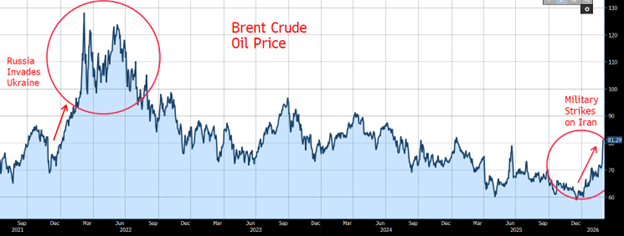
The Federal Reserve conducted research on that 2022 oil surge. They noted that a price increase of $45 per barrel translated into approximately 1 percentage point of headline inflation. However, the impact could vary based on the duration and nature of the shock and the associated policy response.
The Strait of Hormuz—a narrow waterway bordering Iran—has major strategic importance, with roughly 20% of global oil supply passing through it each day. After Iranian attacks on three commercial vessels on Sunday, shipping traffic through the strait has largely paused, as shipowners and insurers reassess risk. If Iran or its allies meaningfully disrupt shipping for an extended period, oil prices could rise further and remain elevated. Sustained price increases would contribute to broader inflationary pressures. Conversely, if the conflict remains relatively contained and shipping resumes with added security measures, upward pressure on oil prices may begin to ease.
Two structural factors provide important context:
Periods like this one reinforce why we construct broadly diversified portfolios. No single asset class, sector, or region should determine outcomes. A well‑designed portfolio includes exposure across U.S. and international equities, fixed income, alternatives, and real assets—each of which tends to behave differently during periods of geopolitical stress.
Key investment principles remain essential:
Geopolitical events highlight the value of diversification across regions, sectors, and asset classes. Our international equity exposure is intentionally concentrated in developed markets such as Europe, the United Kingdom, and Japan, with a smaller allocation to emerging‑market countries. Direct exposure to the region most affected by this conflict is limited. Many companies within our international allocation also generate revenue globally, adding another layer of diversification.
Our diversification discipline extends to other investment categories. Across fixed income, high‑quality bonds continue to provide stability, helping offset equity volatility while offering reliable income. Real assets—such as infrastructure, precious metals, commodities, and real estate—serve as natural hedges during periods of geopolitical tension or inflation pressure.
Risk management is an ongoing process. Increased volatility can create opportunities to trim appreciated positions and rebalance toward long‑term targets. We do not advocate sudden changes based solely on headlines. Instead, we maintain a long-term perspective reviewing economic data as well as market signals, and our evolving outlook will guide any adjustments.
As always, we are here to help. Please contact your wealth‑management team with any questions or if you would like to discuss your portfolios in greater detail. Our contact information is listed below.
Thomas Hudson, CFA
Senior Portfolio Manager and Investment Strategist
Office Phone: (603) 513-4091
thomas.hudson@ledyard.bank
Jeff Gendron, CAIA, CEPA, Chartered SRI Counselor™
Senior Portfolio Manager and Investment Strategist
Office Phone: (603) 513-4086
jeff.gendron@ledyard.bank

 ONWARD