
A great mission and successful fundraising drive nonprofit success. However, sustaining and building upon their initiative also requires a strong financial structure.
Many organizations focus their energy on cultivating donors, writing grants, and generating revenue. Understandably so – it’s a proven playbook that directly supports the mission behind their existence. But fundraising alone doesn't guarantee organizational resilience or sustainability.
In fact, according to a 2025 Nonprofit Finance Fund (NFF) survey, 36% of organizations ended 2024 with an operating deficit, the highest amount in the survey’s 10 years.
The most successful nonprofits endure economic uncertainty, leadership transitions, and funding changes not because they have the most inspiring mission, but because they follow a financial framework built for today's needs and tomorrow's opportunities.
It’s a framework that can be illustrated through a simple three-bucket roadmap.
Operating cash covers the day-to-day realities of running a nonprofit, including payroll, program expenses, vendor payments, and other ongoing costs that help keep the organization running. These require enough liquidity and cash flow to cover costs and keep the organization operational.
Financial experts typically recommend maintaining three to six months of operating expenses in cash reserves. Yet 52% of nonprofits have 3 months or less cash on hand and nearly 1 in 5 have one month or less. A lack of reserves exposes the organization to risk, offering little flexibility if an unexpected expense arises, a grant is delayed, or there’s a dip in fundraising.
But successfully managing operating cash goes beyond just having enough on hand. It requires having the right tools in place, including:
It’s also worth looking closely at any idle cash, funds above and beyond your reserve that are just sitting in a low-yield checking account. While they may offer a sense of added security, they could and should be working for you. When operating reserves exceed your near-term needs, it’s worth considering Bucket Two.
This is the bucket that’s most often overlooked. A quasi-endowment, sometimes called a board-designated reserve fund, is money set aside by the board for investment and growth. In that way, it functions like an endowment. However, unlike a true endowment, it can be accessed if necessary.
The combination of growth and flexibility makes it a valuable tool that offers:
Consider transitioning excess operating cash into a quasi-endowment if you have consistently ended the year with meaningful cash beyond your reserve target. Other scenarios could include a major gift that exceeds your immediate needs or proceeds from the sale of an asset.
A true endowment typically consists of donor-restricted funds in which the principal is preserved, and only investment returns are available for spending, allowing for continuous growth. It demonstrates a purposeful long-term approach.
Endowments are not just for large institutions. Any organization with a long-term mission and a donor base willing to invest in permanence can build one. What matters is having the governance structure to steward it responsibly through:
A well-managed endowment provides permanently invested principal that produces a continuous stream of funds. It’s an always-on funding tool that creates the resilience to pursue your mission long-term, regardless of short-term conditions.
Financially healthy nonprofits make use of all three buckets, with each serving a different time horizon.
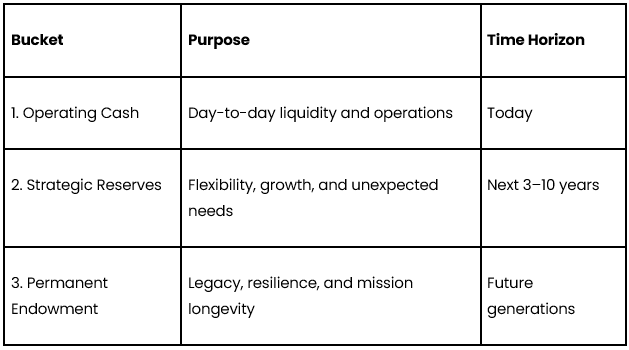
How and when you fund each bucket should be based on your organization's size, stage, and priorities. A newer organization may focus primarily on Bucket One while building toward Bucket Two. A more established organization with the first two buckets established may focus on Bucket Three.
The three-bucket framework shouldn’t be viewed as a checklist. It's a way to think about financial health that evolves with your organization. The point isn’t to have all three buckets fully funded, but to have an intentional approach to each one.
Beyond investing, a strong financial framework is a reflection of your organization’s leadership. Board members carry a fiduciary responsibility that includes ensuring your financial structure supports your mission today and provides the resilience to serve future generations. A well-designed financial framework allows you to put that responsibility into practice.
If you have questions about your organization's financial foundation or would like to learn more about implementing the Three Bucket framework, we're here to help. Ledyard Wealth Management partners with nonprofits across New Hampshire, Vermont, and beyond to build financial strategies that support your mission today and sustain its impact for generations to come.
Watch the replay of Mission to Momentum: Financial Strategies for Sustainable Impact, a 45-minute virtual workshop tailored for nonprofit leaders and board members. Learn practical financial strategies to strengthen your organization's future and maximize your impact.
If you'd like to connect to discuss more, we encourage you to book a call with Scott Coulter.

 ONWARD